
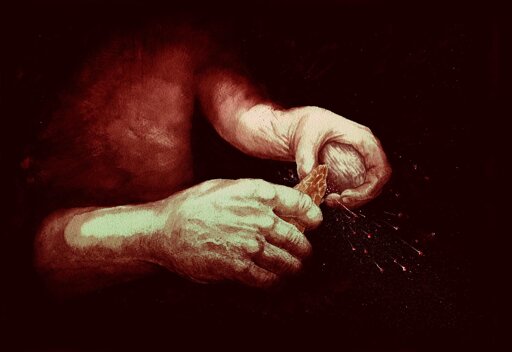
The findings, described in the journal Nature, push back the earliest known date for controlled fire-making by roughly 350,000 years. Until now, the oldest confirmed evidence had come from Neanderthal sites in what is now northern France dating to about 50,000 years ago.
The discovery was made at Barnham, a Paleolithic site in Suffolk that has been excavated for decades. A team led by the British Museum identified a patch of baked clay, flint hand axes fractured by intense heat and two fragments of iron pyrite, a mineral that produces sparks when struck against flint.
Researchers spent four years analyzing to rule out natural wildfires. Geochemical tests showed temperatures had exceeded 700 degrees Celsius (1,292 Fahrenheit), with evidence of repeated burning in the same location.
Discovery of the first fragment of iron pyrite in 2017, at Barnham, Suffof, England. Credit: Jordan Mansfield/Pathways to Ancient Britain Project via AP
That pattern, they say, is consistent with a constructed hearth rather than a lightning strike.
Rob Davis, a Paleolithic archaeologist at the British Museum, said the combination of high temperatures, controlled burning and pyrite fragments shows “how they were actually making the fire and the fact they were making it.”
…
Chris Stringer, a human evolution specialist at the Natural History Museum, said fossils from Britain and Spain suggest the inhabitants of Barnham were early Neanderthals whose cranial features and DNA point to growing cognitive and technological sophistication
One thing I learned from the book “Sapiens” is that there were actually five human species alive a mere 50K yrs ago, suggesting that it’s not unusual for there to be multiple types of humans alive going back to the very conceptual beginning of the great apes known as “humans,” 2+ million years ago.
Anyway, Homo erectus was the preeminent human alive ~1Mya, but there were evidently others, such as H. antecessor, H. habilis, and Paranthropus boisei.