Title text:
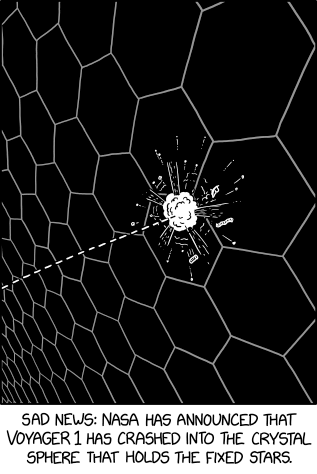
[Several months later] Actaully, it looks like what it hit a few months ago was just the START of the crystal sphere zone. New data confirms Voyager 1 has now struck the ACTUAL crystal sphere.
Transcript:
Transcript will show once it’s been added to explainxkcd.com
Source: https://xkcd.com/3326/
You must log in or register to comment.
Whoever is running the simulation must be busy with generating new data as we keep looking further and deeper and lower. At some point we’ll break their machine.
I thought at first they were talking about this story a short story by David Brin
From the explanation text:
As it sets new distance records, it repeatedly crossed various boundaries which could be considered the edge of the Solar System
The title text pokes further fun at the arbitrariness of these boundaries by re-casting the crystal sphere as a “crystal sphere zone”, making what would otherwise be an objective boundary subjective and fuzzy again. This is a reference to the “crying wolf” period in 2013 of repeated Voyager 1 articles claiming that it had left the solar system.
This is particularly funny if you were following V1 and V2 even before 2013, starting in 2003, say. The probes kept finding new regions of the heliosphere as they went, with the instruments witnessing quite unexpected behaviour in terms of the “flow” of interstellar material out there. And that was even after “hitting the wall” where the solar wind flow drops below supersonic. Hell, we’re still coming across discrete boundaries and structures in the plasma even now, when most heliophysicists are sure the probes have gone interstellar. For a few years back there, I wondered if even the faster V1 would ever reach the “edge”, whatever that means. It sure took a while; before the Voyagers launched, some of the scientists thought we’d reach the solar wind boundary around freaking Saturn…
Better not show this xkcd to the Flat Earth types. If they do show up, though, we can always trot out one of those good old Richard Matheson Twilight Zone bogeymen to keep them in their place.
And that was even after “hitting the wall” where the solar wind flow drops below supersonic.
What does “supersonic” even mean in the context of the outer solar system? I assume it has no relation to the 700ish MPH that it is in air at STP.
The medium here is the solar wind plasma as opposed to Earth’s atmosphere, but the waves are still acoustic, so the term “supersonic” is used widely in this sort of magnetohydrodynamic space physics. At 300-400 km/s, or often even faster, the outward-flowing solar plasma outruns the waves generated within the plasma itself (as it interacts with the weak magnetic fields). So yes, your assumption was correct.
Thanks, that helps clear it up.
Though I have to admit, I’m mildly surprised the plasma is dense enough to interact with itself in waves at all. You mentioned “weak magnetic fields;” is that qualitatively different from molecules bumping into each other in a more familiar fluid of Earth-like density? (Kinda like how a Newton’s cradle is different from a stack of floating ring-shaped magnets on a stick?)
I know what you mean about the density seeming too low, I’d often do a double-take as well when I was introduced to plasma physics. I can’t claim to understand all the bulk behaviour of the plasma out there, but it is certainly a collisionless fluid, so nothing like what we see in a planetary atmosphere, not even the outermost layers. I recall reading that individual particles have a mean free path of ~1 AU, so they can literally go from the Sun to the Earth without colliding. The particles are spiraling along the magnetic field lines anyway, though, and the lines extend all the way back to the Sun whence they originate, so visualizing them is very necessary to understand this stuff. The field strength may be small, but we’re talking individual electrons and ions here.
As for wave interactions, the thing is that they are being generated upstream and downstream of any individual particle, so I find it easier to imagine the fluid is being “bathed” pretty widely, so to speak. And that’s before you consider plasma waves… yeah, maybe I’m not cut out to be a heliophysicist.
That’s pretty similar to the premise of Unsong, which is in my opinion a fucking masterpiece.
Never heard of it before, but I’m enjoying it
Somehow I still have to actively force myself to not thinking there is something like this when looking at the nightsky. And then it’s always such a surreal realization that I am actually looking into vast deep infinite space and also thousand, million, billion years into the past.
We’re in a marble
Ultron could have gotten through

Exactly! Miss me with that “crystal sphere” nonsense. I know a Q matrix when I see one.
Crooklyn Dodgers represent
Flew too close to the
sunfirmament
Of course it did. Got to keep that phlogiston out of wild space.
Imagine if it broke and shattered. Would be some shit.
There’s a short sci-fi story by Stephen Baxter about something very similar to this. Humanity manages to resolve a planet around one of the stars of Alpha Centauri and finds a way to bounce a laser off it in such a way that we’d see the reflection after about 8 years.
… except things don’t go quite how they expect. Reality itself starts glitching as the humanity of that universe begins to realise that they weren’t expected to have been able to reach that far. At least, maybe not yet…?
Come on, where’s the title?
“Touching Centauri”
Edit: Somehow also reminds me of Asimov’s “The Gods Themselves”
There’s also Unsong, which is one of my favorite books.
The Apollo 8 spacecraft collides with the crystal sphere surrounding the world, seriously damaging the machinery of the universe, which among other things causes a silicon valley arms-race to brute-force discovering the true names of god, which now have actual power.
I won’t spoil the rest, but this book is really great.This sounds like fun!
Frayed copper wire?
Failed update?
Phishing?
Personally, I think it’s for the best if we’re not let out into wider space.