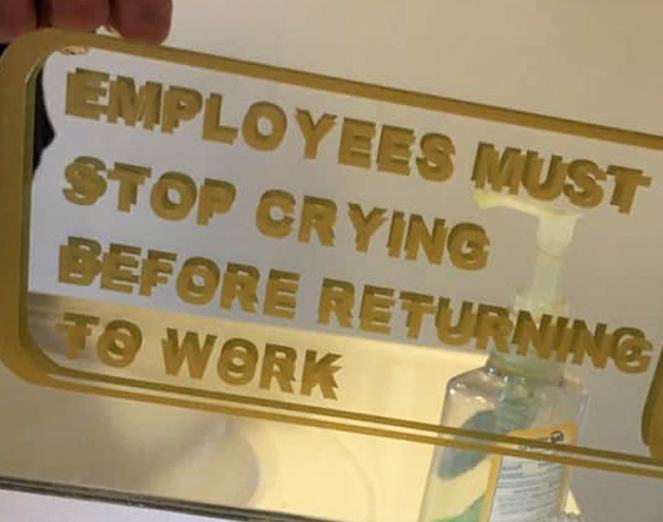
“feature”


“feature”


If people were looking at this intelligently, they’d clearly see that AI is heavily subsidized and you can use the subsidized help to fix your broken shit without becoming completely dependent upon it being subsidized forever.
But stupid is as stupid does, so they’ll all just continue to add unhelpful chatbots to their software and token consuming nonsense workflows instead of fixing any quantity of their huge amount of open problems.


Algorithmic music is incredible for discovery and that’s about it.
This may be true for most but was not for me. I was on streaming services for two years and discovered maybe five new bands. I went back to my old process of discovery (reading magazines, reading online reviews) and discover many more every year.
Algorithms tend to pump you full of similar sounding artists. I’d rather be challenged as a listener and grow than be stuck in a same sounding culdesac.


Bandcamp is good for this. You can stream stuff you bought on there for free through the app if you want to. I download my purchases and add them to my enormous library that I started in the late nineties.


Since a plane requires the most thrust at takeoff, you could use ground-based catapults to get the plane to takeoff speed (or faster even) and then you could carry smaller batteries and propelling machinery.
Don’t you dare talk about catapulting using electric technologies in America though. Steam only! 🇺🇸🗽🦅🏈


Also “automating a workflow” IMO shouldn’t involve having an agent at the end. If tokens and cloud models with selling a dollar for a quarter pricing levels are required for your automated workflow to work, you’ve set up a ticking time bomb.
Use this subsidized garage to churn out regular automation that you can maintain after the merry go round inevitably stops. I was told as much by Microsoft AI specialists themselves. Do not toss out working ci/cd processes in favor of putting a chatbot in the middle, because who knows if you’ll still be able to run that chatbot in a couple of years.


Sure, and also social security is the opposite of need based as well. So those people who paid tax on a tiny fraction of their income also see the largest checks after retirement age when they need zero percent of the money. Meanwhile, people who worked their whole lives and paid social security tax on 100% of their earnings don’t get enough back from social security to be able to continue to live.


I think this is honestly one of those 100% vs >80% issues. I get that it’s very possible — maybe even easy — to subvert this, but we have had several SITTING POLITICIANS read a fucking AI prompt in the middle of their “big speech” and nobody bats an eye. If they add a measure to outputs that works automatically for 100% of outputs without the people reading it knowing, there’s no chance that it won’t allow you to determine whether or not many outputs are AI.


They aren’t even actually probabilistic. They’re deterministic with pretend probabilistic characteristics.
Pseudo-random is pseudo. It isn’t really random. That’s why some of them have a setting called a “temperature”. They’re just a fucking program they should have a seed value to behave 100% predictably from the same prompt. The people who own them are fucking responsible and obviously so.


But think of the poor insurance company CEOs whose kids might be doomed to flying commercial! 😭


Think of the poor, starving slumlords before passing that anti-rent gouging bill!


And maybe your point is what Doctorow was trying to make all along, but he pushed too far in the other direction? Even now, Code Generation is a useful tool, as long as it’s used as only a tool by someone who knows what they’re doing.
In this piece — which I read via RSS feed a number of weeks ago before it was published in this medium — he is writing about what most peoples’ experience is in a company where they have decided to “do AI”, and what most CEOs think about when they think about “doing AI”.
This usually comes in the form of a company chatbot or “agentic workflow”, and in the vast majority of cases these things are very much not helpful and can actively be annoying because attention is paid to developing these things when more practical and useful features could be developed instead (see: https://ludic.mataroa.blog/blog/i-will-fucking-piledrive-you-if-you-mention-ai-again/).
In other pieces, he discusses — using what I would call sort of esoteric terms that he often defines inline — people in saner places that get to choose how and why to use AI to assist with their jobs. But that’s not the majority of people’s experiences and that is certainly not what CEOs are often talking about.
I think he’s being somewhat hyperbolic in this particular piece, and maybe that’s due to the amount of “AI is changing everything” or “AI has changed everything” that is appearing in LinkedIn / X posts everywhere, when it’s difficult for most to even name a single thing that the chatbot has spit out that has improved lives, and the vendored chatbot attached to an existing piece of software (which is mostly what people end up doing when they “do AI” at a company) is completely useless.
If I take myself as an example, he’s largely right that I have to play this game with internal development teams that come up with “agentic workflows” and try to get me to use them to do my job when it’s a lot easier and better to just…use Claude code myself.
AI hasn’t “changed everything”. The only thing it’s really done so far is produce a lot of chatbots and agentic workflows that aren’t very useful. It remains to be seen if: (1) it can ever be made to work more efficiently, (2) if you can ever actually run a profitable business building or running a “neocloud”, and (3) what the broader effects on software will be from mass usage of this technology.
The early signals on all of these very real concerns (not to mention others such as environmental, cultural, and economic impact) are not very positive.


I agree with that as well. A lot of the problem with my current company comes straight from the executive leadership level. I’m afraid that the culture will only change when they change (or more likely, the company will eventually just go bust).
They bought the lie that AI will replace all of software engineering, whereas I see the picture more like this:
https://www.normaltech.ai/p/why-ai-hasnt-replaced-software-engineers
A CEO that thinks that they’re going to develop all of the software, even with Claude code, is nuts. They simply do not have the necessary skill set to run a software project even if 100% of the hands-on programming is done by AI. They are not going to be sitting there telling a machine to move things around on a web app. They are going to believe the bot when it says that “it is implemented”.


Which happened without AI, too.
Sure, but not at this speed. The bots can churn out a mountain of non-sense that does not work faster than people can review it and the bots themselves will lie to you and say “it’s all implemented”.
For people who have clear ideas of what to implement but struggle to find the time, this is a big gift. You can work hand-in-hand with the bot and say “nope, not that, this” until it implements what you had in mind. For aimless corporations with “ideation” meetings who cannot stop coming up with terrible ideas that none of their customers want, it’ll hasten the process of them making their software worse over time.
That’s exactly what I’m seeing at my current company.


He’s not wrong. He’s talking about what everyone else is talking about and you’re arguing semantics. AI is generic enough of a term that it’s been applied to thousands of things over time. But almost all of the modern hype about “AI” and the stock bubble and everything is referring to the chatbots. I know you know this.


It depends on the tool to be honest. If it’s Claude code and you’re a programmer, sure that’s helpful. But often it’s an “agentic workflow engine” that’s been developed in house that’s complete garbage, or a chatbot that doesn’t know anything telling you that it can’t answer your question that was put together by your company. These custom tools are almost always not helpful.
Doctorow knows this as well, he writes about this crap constantly and has broken it down by user type in other pieces.


The conflict should only really appear if they do increase productivity, and you refuse to use them, resulting in less productivity than your peers.
While it should be easy to point out where this helps, it very much is not in reality because AI accelerates execution on ideas, but corporations nearly always suck much more at deciding which ideas to actually implement in the first place.
I predict that the longer this goes on, the more useless, untested half-features will be stuffed into software and the more bloated “fall back” implementations full of duplicated spaghetti code will exist.
If the tools don’t stick around because it’s too cost prohibitive to keep using them, we’re going to be cleaning up after the bots for a decade.
It’s been a boon for personal slopjects for me. But that’s because I could never find time for execution in the past. Now I just have the (free tier) AI slop up my ideas.


In this way AI reminds me of when Elon was saying we should build a giant vacuum tube instead of a train in California.
They all pretend this AI god that they’re sure will surface will solve the climate crisis partially because they already know what needs to be done and don’t want to do it. They’d rather baffle you with bullshit instead of trying to fix the problem.


When people say AI they are talking about Gen AI chatbots. Pretending they aren’t in a thread discussing an article where the author is definitely talking about chatbots is being really pedantic.
Man I miss the early days of the Internet with the bullshit hit counters that were completely inconsequential when wrong and anyone could game.
Now somehow cuz it’s big business, those same bullshit hit counters can be used to move big mountains of money.