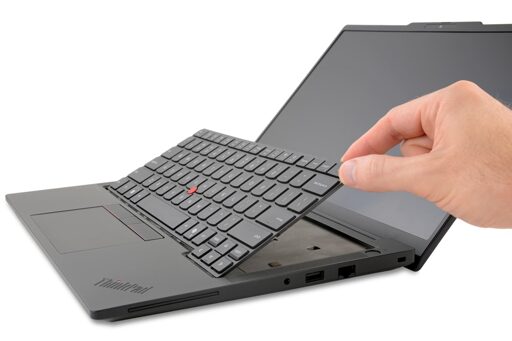
Repair goes mega mainstream with the launch of Lenovo’s new T-series business laptops, which earned our highest honor with a 10/10 repairability score.
There’s a difference between ‘repairable’ and ‘upgradable.’ Most of the comments seem to conflate the two. Lenovo isn’t doing a Framework.
It’s a smart move. Differentiates them from other laptop-makers for corporate IT, who can do the parts swaps themselves. Also smart is associating the brand with iFixit and working to get a 10/10. That’ll be what sets them apart from all the others, at least for the next year or two.
The “upgradability” part in a small laptop is questionable to me, anyway.
The GPU is really compromised in that chassis, as having it in a slot compromises cooling big time, and limits how much power it can use. And while I love upgradable RAM for the CPU… it’d be better if they used faster CAMM modules. Many other brands have upgradable SSDs/WiFi.
Swappable ports are awesome, no question.
…But honestly, I’d rather have a smaller chassis, bigger GPU and better cooling right off the bat, like a Zephyrus chassis. And have it reparable, and make the whole motherboard standardized/swappable, but not compromise the chassis so severely by making it modular.
There’s a difference between ‘repairable’ and ‘upgradable.’
Absolutely! I’ve got a Lenovo IdeaPad Flex 5 (laptop/tablet thingy).
I’ve upgraded/replaced the ssd - no problem.
Unfortunately, this laptop has an issue with the keyboard: the left section/panel intermittently stops sending inputs. Meaning, keys like escape, a, w, shift, l-control - just stop (even in the bios). I’d read that they keyboard “collects” static which causes problems with certain sections of the keyboard.
I thought I’d see how difficult it would be to replace the keyboard. I watched a teardown video, and of course you need to remove everything… but I lost it when, the person in the video used a heat gun to melt “plastic rivits” that connected the keyboard to the motherboard case. Then with the replacement keyboard needed to remelt the plastic rivits.
This laptop is not repairable. In fact, I swore I’d never buy another Lenovo again as a result. … but if their focus is on making them repairable (and their recent partnership with GrapheneOSedit: oops, that’s Motorola and GrapheneOS) - I might be eating crow tonight.
Note that ThinkPad and IdeaPad are practically different companies with how Lenovo acts.
Fully expect IdeaPads to continue to be shit. ThinkPad can do the most wondrous good stuff in the world and IdeaPad will stay garbage.
And yes, I went through the same exact maddeningly shitty keyboard replacement procedure. Never again IdeaPad, though ThinkPad has been fine.
Bonus points, ThinkPad brand never shipped Superfish, and most of the firmware security flaws have been IdeaPad side. It’s amazing how half-assed they are with that brand yet pretty competent with ThinkPad.
A think pad t series is not really much harder to take apart than a framework. Just more screws and fewer magnets. The screen is probably an exception however.
That’s his point. It’s similar to framework, but not the same.
Easy repairability is great, truly.
But framework offers more than that, easy repairability AND upgradability, because they offer new upgraded parts with the same compatibility as the old ones, so you can just drop them in.
Lenovo is not yet doing that. Which is fine. Just a noteworthy difference.

There’s a difference between ‘repairable’ and ‘upgradable.’ Most of the comments seem to conflate the two. Lenovo isn’t doing a Framework.
It’s a smart move. Differentiates them from other laptop-makers for corporate IT, who can do the parts swaps themselves. Also smart is associating the brand with iFixit and working to get a 10/10. That’ll be what sets them apart from all the others, at least for the next year or two.
The “upgradability” part in a small laptop is questionable to me, anyway.
The GPU is really compromised in that chassis, as having it in a slot compromises cooling big time, and limits how much power it can use. And while I love upgradable RAM for the CPU… it’d be better if they used faster CAMM modules. Many other brands have upgradable SSDs/WiFi.
Swappable ports are awesome, no question.
…But honestly, I’d rather have a smaller chassis, bigger GPU and better cooling right off the bat, like a Zephyrus chassis. And have it reparable, and make the whole motherboard standardized/swappable, but not compromise the chassis so severely by making it modular.
Absolutely! I’ve got a Lenovo IdeaPad Flex 5 (laptop/tablet thingy).
I’ve upgraded/replaced the ssd - no problem.
Unfortunately, this laptop has an issue with the keyboard: the left section/panel intermittently stops sending inputs. Meaning, keys like escape, a, w, shift, l-control - just stop (even in the bios). I’d read that they keyboard “collects” static which causes problems with certain sections of the keyboard.
I thought I’d see how difficult it would be to replace the keyboard. I watched a teardown video, and of course you need to remove everything… but I lost it when, the person in the video used a heat gun to melt “plastic rivits” that connected the keyboard to the motherboard case. Then with the replacement keyboard needed to remelt the plastic rivits.
This laptop is not repairable. In fact, I swore I’d never buy another Lenovo again as a result. … but if their focus is on making them repairable (
and their recent partnership with GrapheneOSedit: oops, that’s Motorola and GrapheneOS) - I might be eating crow tonight.Note that ThinkPad and IdeaPad are practically different companies with how Lenovo acts.
Fully expect IdeaPads to continue to be shit. ThinkPad can do the most wondrous good stuff in the world and IdeaPad will stay garbage.
And yes, I went through the same exact maddeningly shitty keyboard replacement procedure. Never again IdeaPad, though ThinkPad has been fine.
Bonus points, ThinkPad brand never shipped Superfish, and most of the firmware security flaws have been IdeaPad side. It’s amazing how half-assed they are with that brand yet pretty competent with ThinkPad.
A think pad t series is not really much harder to take apart than a framework. Just more screws and fewer magnets. The screen is probably an exception however.
That’s his point. It’s similar to framework, but not the same.
Easy repairability is great, truly.
But framework offers more than that, easy repairability AND upgradability, because they offer new upgraded parts with the same compatibility as the old ones, so you can just drop them in.
Lenovo is not yet doing that. Which is fine. Just a noteworthy difference.
I would be curious to see how often people actually upgrade their frameworks.
I agree with their repair stance. It just feels like one of those things people will tell you they want and then never do.
Still maybe the explosion in memory prices will change the incentives and people will start holding things longer. It will be interesting to see.