Welfare can be a part of a capitalist or socialist system, but is not those systems itself. You are trying to slice up parts of a cohesive system and treat those constituent parts as though they form an independent system themselves, but this is incorrect. The consequences of this error result in confused understandings of bodies like the US military as “socialism,” despite being a tool of monopoly finance capital. This is why the identity of an overall system is in its principal aspect, as this principal aspect determines how the rest of the system functions.
As for the USSR, it was run by the working classes. Classes are relations to ownership of production and distribution, not simply income levels or levels of administrative authority. You are referring to workers in the central committee and CPSU as “elites,” yet they were paid wages and did not own any capital. Just like a principal is the same class as a teacher, so too are administrators in socialist economies the same class as factory workers. The USSR had a form of democracy that began at the local level, and laddered upwards through councils called Soviets.
The US Empire is not democratic. The only viable political parties are those run and owned by capitalists, so candidates are representatives of that class. The media is owned by the capitalist class as well. The majority does not run society, they pick between outcomes already decided as okay by the capitalist class.
In trying to slice up systems and pretend there is no meaningful interaction between these, and that instead these systems are functionally independent, you are making metaphysical errors in analysis.
You are trying to slice up parts of a cohesive system and treat those constituent parts as though they form an independent system themselves, but this is incorrect.
Ah, I see the issue here. I am not arguing that the system is entirely capitalist or socialist. I am arguing that a system can contain sectors that operate under one system while other sectors operate under the other. The “principal aspect” certainly applies as a general description of the whole, but that doesn’t change the nature of individual elements.
Classes are relations to ownership of production and distribution, not simply income levels or levels of administrative authority
I would argue classes are determined by power. In the USSR, the power was held by the government and organized crime, not workers.
The US is a democratic republic. No matter how much capital you have, you can’t gain power without convincing people to vote for you. Granted money makes this easier, but it is not sure thing. Look at Elon Musk. He tried to use his money to force his way into government with that DOGE thing, but it failed miserably and he was pushed back.
The majority does not run society, they pick between outcomes already decided as okay by the capitalist class.
Was it any different in the USSR with the party making all the choices? Power always sets up the game board we all play on.
The principal aspect of the economy is the driving force of the economy, and determines the direction in which it develops. It does not change whether private property is private or not, but it does determine what that private property is submitted to, either it’s dominant over the economy or it’s submissive to it. To see this in practice, you can look at the FDA, and how it’s in bed with big pharma to secure drug patents and help profits over the people. This is not socialism and capitalism working together, but public property helping the dominant private property in the context of a capitalist system.
Classes are not something as vague as “power.” The reason classes are directly related to ownership of the means of production is because classes have shared class interests. The USSR was governed by the working classes, with the most energetic among them elected to become members of the Communist Party, upon which they were subjected to criticism if they did not perform well. The party regularly purged those the working classes did not support, and replenished its ranks from the rest of the working classes.
The US is a dictatorship of capital, and is far less democratic than the USSR was. Even your example of Elon Musk is horribly flawed, he was not kicked out by workers, but by rival capitalists. The class dictatorship of the US always supports that class, not necessarily any and all individuals belonging to that class. This is why class analysis is important.
And to answer your question, yes, it was very different in the USSR. Factory councils, village committees, and more were run democratically. Administration was highly veted and came from the best among the working classes, and the members of the party were subject to open criticism. Corruption often came, as it does in any society, but the CPSU made a deliberate effort to kick out lazy and corrupt officials, and replenish their ranks from the working classes. This is why the Soviet Union was run by engineers, professors, miners, factory workers, and more, not capitalists like the US.
This is not socialism and capitalism working together, but public property helping the dominant private property in the context of a capitalist system.
Corruption is a problem with any system. Capitalism or communism is irrelevant. Marx would probably argue that greed is a social construct, but I think psychology has conclusively shown that while elements of greed are social, it is fundamentally an evolutionary adaptation (as is altruism).
The reason classes are directly related to ownership of the means of production is because classes have shared class interests.
Ownership of the means of production is just a type of power. It is the power to grant or deprive others of resources. Shared interests by class is another falsehood bred from lack of psychological understanding by Marx. A black woman who works at a grocery store in a city and a white male farmer from a rural area are the same class to Marx. However their interests are vastly different because of intersectionality (which Marx had no way to know about).
The US is a dictatorship of capital, and is far less democratic than the USSR was.
The USSR was on no way democratic. It was an authoritarian state with one party who regularly presented voters with one single party-approved candidate to vote for. The public was not allows fundamental democratic principles like freedom of speech or independent political opposition. Stalin literally won 100% of the vote because of uncontested elections.
The US political system is heavily impacted by capital, but capital isn’t a single entity. It is a wide range of groups with a wide range of conflicting interests. Beyond limiting government regulation of capital and taxation, they rarely agree. Capital spends heavily influencing voters opinions, BUT the voters do still vote and those votes are counted honestly. We absolutely need to get money out of politics and we need to get rid of first past the post style voting. That being said, we are a democracy. And imperfect democracy, but a democracy.
It’s not that greed or altruism are social constructs, but that the way we think and see the world is based on how we produce and distribute. This is more affirming Marxism as correct, and psychological advancements marrying perfectly with Marxism already. Again, more misunderstandings of Marxism on your part.
Same with class. When you identify the differences between different nationalities among the proletariat, you are correctly identifying different interests, but incorrectly erasing class. Both the woman and the man have the same class interests in collectivizing the means of production and distribution. You’re, again, misunderstanding the Marxist position, and arguing against a strawman version of Marxism.
As for the USSR, it was comprehensively democratic and run by the working classes. First-hand accounts from Statesian journalist Anna Louise Strong in her book This Soviet World describe soviet elections and factory councils in action. Statesian Pat Sloan even wrote Soviet Democracy to describe in detail the system the soviets had built for curious Statesians to read about, and today we have Professor Roland Boer’s Socialism in Power: On the History and Theory of Socialist Governance to reference.
Meanwhile, the US is a dictatorship of capital. You are confusing the ability to vote for the presence of democracy, but the truth is that the only allowable choices are already preselected by the capitalist class. It’s like forcing someone to pick between having their foot or hand cut off, and claiming their decision was democratic and desirable.
It’s not that greed or altruism are social constructs, but that the way we think and see the world is based on how we produce and distribute.
That is literally what Marx believed. He did not believe in biology as a driver of greed in any way.
Both the woman and the man have the same class interests in collectivising the means of production and distribution.
As you point out, people act against their perceived best interests. This is driven by the non-class differences that you so easily dismiss.
As for the USSR, it was completely democratic and run by the working classes.
Objectively false. The government was run solely by the Communist Party and they could not be voted out. No competing parties were allowed. Nobody who did not belong to the Communist party could run. The system was inherently antidemocratic.
You are confusing the ability to vote for the presence of democracy, but the truth is that the only allowable choices are already preselected by the capitalist class.
Two words: Zohran Mamdani. The capitalist class does not want a brown Muslim democratic socialist running the largest city in the country. The people chose him.
Please, show me where Marx said what you think he did. Explain the dialectical materialist theory of knowledge and how it has been disproven.
As for the men and women, they are not acting against their perceived interests, you did not explain this one bit. They both believe themselves to be acting in their own interests.
As for the USSR, you are factually wrong. The soviets had recall elections, and party members were subjected to criticism by the public. People outside of the communist party could and did run. Competing parties were not allowed, but that’s the only thing correct you said. I linked you mountains of evidence.
As for Mamdani, you’ll find that he cannot implement socialism even if he wanted to. It’s theatrics, they will never allow actual change, at best a bone tossed to the public. Even then, you can see that capitalists are kicking it into gear to prevent his reforms from taking place. Mamdani proves me correct.
The dialectical materialist theory of knowledge is not a scientific hypothesis that can be “disproven” in a laboratory, but rather a philosophical framework. Critics widely reject it because it is unfalsifiable, imposes abstract rules onto empirical science, and relies on vague definitions.
They both believe themselves to be acting in their own interests.
You are missing the point. Their class interest is not their only interest. Various interests can take precedence over class interest.
People outside of the communist party could and did run.
Were they allowed to win? How often did they “accidentally” fall out of windows? Were the votes for them actually counted? No, the USSR was not a democracy. There was no free speech. The government heavily policed and punished dissent. Without free speech there can be no democracy.
As for Mamdani, you’ll find that he cannot implement socialism even if he wanted to.
You should know that democratic socialism is different and he is already implementing it. He is creating real tangible change. Sure, he can’t transform the whole system alone, but for one person in a position of power he is doing a lot. Your idea that a cabal of capitalists control the government is nothing less than a conspiracy theory.


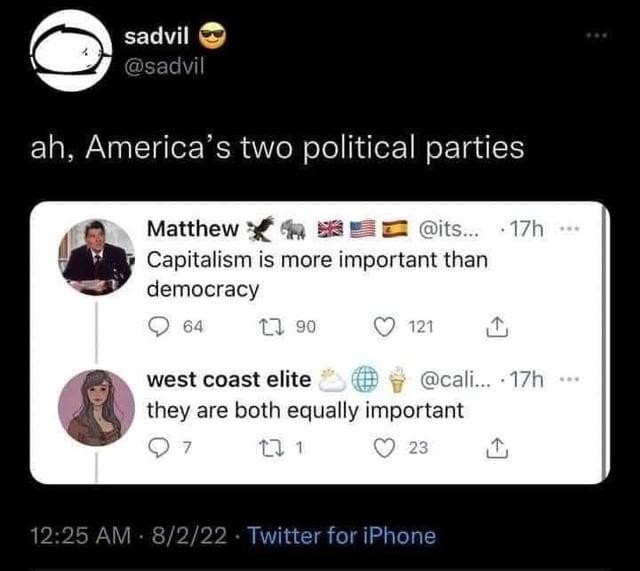
Welfare can be a part of a capitalist or socialist system, but is not those systems itself. You are trying to slice up parts of a cohesive system and treat those constituent parts as though they form an independent system themselves, but this is incorrect. The consequences of this error result in confused understandings of bodies like the US military as “socialism,” despite being a tool of monopoly finance capital. This is why the identity of an overall system is in its principal aspect, as this principal aspect determines how the rest of the system functions.
As for the USSR, it was run by the working classes. Classes are relations to ownership of production and distribution, not simply income levels or levels of administrative authority. You are referring to workers in the central committee and CPSU as “elites,” yet they were paid wages and did not own any capital. Just like a principal is the same class as a teacher, so too are administrators in socialist economies the same class as factory workers. The USSR had a form of democracy that began at the local level, and laddered upwards through councils called Soviets.
The US Empire is not democratic. The only viable political parties are those run and owned by capitalists, so candidates are representatives of that class. The media is owned by the capitalist class as well. The majority does not run society, they pick between outcomes already decided as okay by the capitalist class.
In trying to slice up systems and pretend there is no meaningful interaction between these, and that instead these systems are functionally independent, you are making metaphysical errors in analysis.
Ah, I see the issue here. I am not arguing that the system is entirely capitalist or socialist. I am arguing that a system can contain sectors that operate under one system while other sectors operate under the other. The “principal aspect” certainly applies as a general description of the whole, but that doesn’t change the nature of individual elements.
I would argue classes are determined by power. In the USSR, the power was held by the government and organized crime, not workers.
The US is a democratic republic. No matter how much capital you have, you can’t gain power without convincing people to vote for you. Granted money makes this easier, but it is not sure thing. Look at Elon Musk. He tried to use his money to force his way into government with that DOGE thing, but it failed miserably and he was pushed back.
Was it any different in the USSR with the party making all the choices? Power always sets up the game board we all play on.
The principal aspect of the economy is the driving force of the economy, and determines the direction in which it develops. It does not change whether private property is private or not, but it does determine what that private property is submitted to, either it’s dominant over the economy or it’s submissive to it. To see this in practice, you can look at the FDA, and how it’s in bed with big pharma to secure drug patents and help profits over the people. This is not socialism and capitalism working together, but public property helping the dominant private property in the context of a capitalist system.
Classes are not something as vague as “power.” The reason classes are directly related to ownership of the means of production is because classes have shared class interests. The USSR was governed by the working classes, with the most energetic among them elected to become members of the Communist Party, upon which they were subjected to criticism if they did not perform well. The party regularly purged those the working classes did not support, and replenished its ranks from the rest of the working classes.
The US is a dictatorship of capital, and is far less democratic than the USSR was. Even your example of Elon Musk is horribly flawed, he was not kicked out by workers, but by rival capitalists. The class dictatorship of the US always supports that class, not necessarily any and all individuals belonging to that class. This is why class analysis is important.
And to answer your question, yes, it was very different in the USSR. Factory councils, village committees, and more were run democratically. Administration was highly veted and came from the best among the working classes, and the members of the party were subject to open criticism. Corruption often came, as it does in any society, but the CPSU made a deliberate effort to kick out lazy and corrupt officials, and replenish their ranks from the working classes. This is why the Soviet Union was run by engineers, professors, miners, factory workers, and more, not capitalists like the US.
Corruption is a problem with any system. Capitalism or communism is irrelevant. Marx would probably argue that greed is a social construct, but I think psychology has conclusively shown that while elements of greed are social, it is fundamentally an evolutionary adaptation (as is altruism).
Ownership of the means of production is just a type of power. It is the power to grant or deprive others of resources. Shared interests by class is another falsehood bred from lack of psychological understanding by Marx. A black woman who works at a grocery store in a city and a white male farmer from a rural area are the same class to Marx. However their interests are vastly different because of intersectionality (which Marx had no way to know about).
The USSR was on no way democratic. It was an authoritarian state with one party who regularly presented voters with one single party-approved candidate to vote for. The public was not allows fundamental democratic principles like freedom of speech or independent political opposition. Stalin literally won 100% of the vote because of uncontested elections.
https://www.nytimes.com/1937/12/14/archives/stalin-wins-poll-by-a-vote-of-100-no-opposition-is-shown-in-count.html
The US political system is heavily impacted by capital, but capital isn’t a single entity. It is a wide range of groups with a wide range of conflicting interests. Beyond limiting government regulation of capital and taxation, they rarely agree. Capital spends heavily influencing voters opinions, BUT the voters do still vote and those votes are counted honestly. We absolutely need to get money out of politics and we need to get rid of first past the post style voting. That being said, we are a democracy. And imperfect democracy, but a democracy.
It’s not that greed or altruism are social constructs, but that the way we think and see the world is based on how we produce and distribute. This is more affirming Marxism as correct, and psychological advancements marrying perfectly with Marxism already. Again, more misunderstandings of Marxism on your part.
Same with class. When you identify the differences between different nationalities among the proletariat, you are correctly identifying different interests, but incorrectly erasing class. Both the woman and the man have the same class interests in collectivizing the means of production and distribution. You’re, again, misunderstanding the Marxist position, and arguing against a strawman version of Marxism.
As for the USSR, it was comprehensively democratic and run by the working classes. First-hand accounts from Statesian journalist Anna Louise Strong in her book This Soviet World describe soviet elections and factory councils in action. Statesian Pat Sloan even wrote Soviet Democracy to describe in detail the system the soviets had built for curious Statesians to read about, and today we have Professor Roland Boer’s Socialism in Power: On the History and Theory of Socialist Governance to reference.
Meanwhile, the US is a dictatorship of capital. You are confusing the ability to vote for the presence of democracy, but the truth is that the only allowable choices are already preselected by the capitalist class. It’s like forcing someone to pick between having their foot or hand cut off, and claiming their decision was democratic and desirable.
That is literally what Marx believed. He did not believe in biology as a driver of greed in any way.
As you point out, people act against their perceived best interests. This is driven by the non-class differences that you so easily dismiss.
Objectively false. The government was run solely by the Communist Party and they could not be voted out. No competing parties were allowed. Nobody who did not belong to the Communist party could run. The system was inherently antidemocratic.
Two words: Zohran Mamdani. The capitalist class does not want a brown Muslim democratic socialist running the largest city in the country. The people chose him.
Please, show me where Marx said what you think he did. Explain the dialectical materialist theory of knowledge and how it has been disproven.
As for the men and women, they are not acting against their perceived interests, you did not explain this one bit. They both believe themselves to be acting in their own interests.
As for the USSR, you are factually wrong. The soviets had recall elections, and party members were subjected to criticism by the public. People outside of the communist party could and did run. Competing parties were not allowed, but that’s the only thing correct you said. I linked you mountains of evidence.
As for Mamdani, you’ll find that he cannot implement socialism even if he wanted to. It’s theatrics, they will never allow actual change, at best a bone tossed to the public. Even then, you can see that capitalists are kicking it into gear to prevent his reforms from taking place. Mamdani proves me correct.
The dialectical materialist theory of knowledge is not a scientific hypothesis that can be “disproven” in a laboratory, but rather a philosophical framework. Critics widely reject it because it is unfalsifiable, imposes abstract rules onto empirical science, and relies on vague definitions.
You are missing the point. Their class interest is not their only interest. Various interests can take precedence over class interest.
Were they allowed to win? How often did they “accidentally” fall out of windows? Were the votes for them actually counted? No, the USSR was not a democracy. There was no free speech. The government heavily policed and punished dissent. Without free speech there can be no democracy.
You should know that democratic socialism is different and he is already implementing it. He is creating real tangible change. Sure, he can’t transform the whole system alone, but for one person in a position of power he is doing a lot. Your idea that a cabal of capitalists control the government is nothing less than a conspiracy theory.