

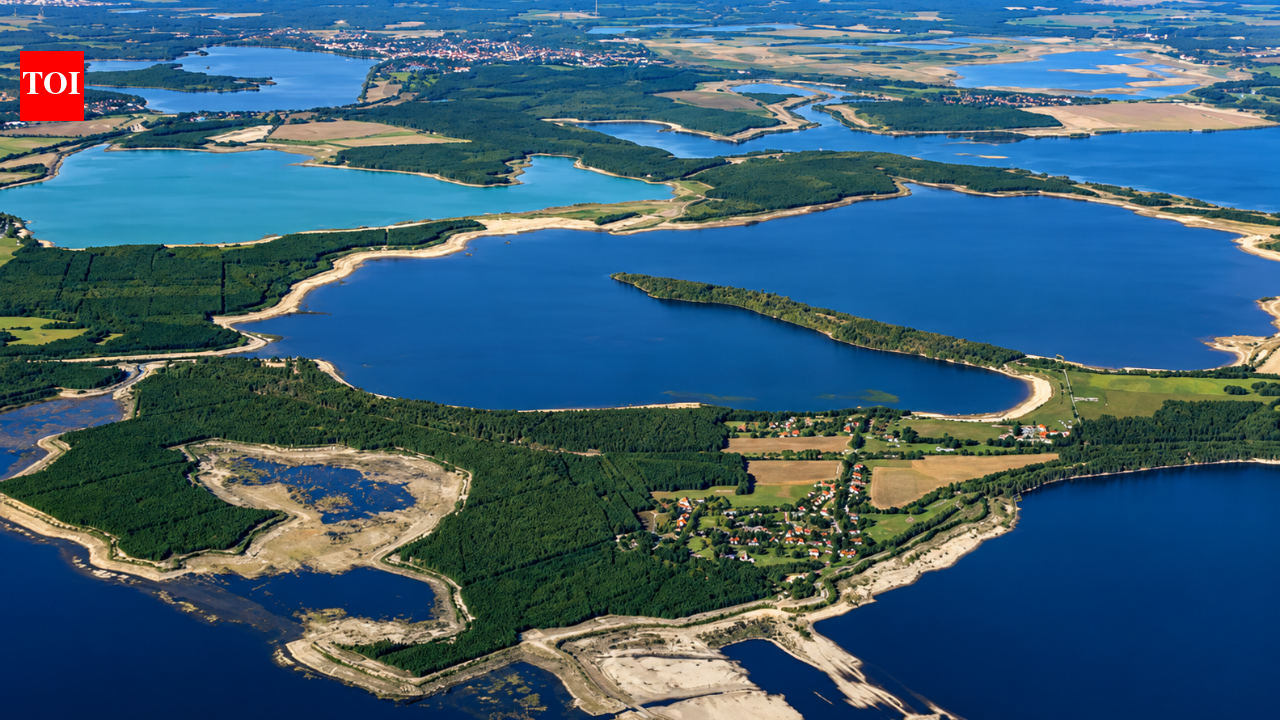
Important to note: These are old open-pit mines from the era of German division. Back then, the GDR didn’t waste any resources on reclamation; instead, it simply shut off the pumps that had kept the pits dry. As a result, they filled with groundwater, and the pyrite contained in the coal seams weathered into sulfuric acid. Long story short: The lakes had to, and still have to in many cases, be heavily limed for renaturation or to make them usable again, since the pH level naturally hovers around pH 4.
According to the “Bundesanstalt für Gewässerkunde” at least for some of the bigger (and older ones) the water quality is “excellent”.
For example Senftenberger See and Geierswalder See. Unfortunately for many of them no data about water quality is publicly available. Probably because they are not open to swimming. Source: https://geoportal.bafg.de/karten/badegewaesser/?page=Seite#zoom_to_selection=true
Yes, but that is due to continues liming of many of those lakes. That is likely to keep happening for the next century or two at least in those lakes, which do not have a river running through them. Even that has issues, as the pollution from those lakes can kill the entire river. There are ways to deal with that too, but it is not a perfect situation.
Thanks for linking this article. It was very interesting to read! Especially the part with rising Groundwater levels and the negative impact on existing buildings that did not plan for rising groundwater levels after the end of the mining in the area.
The building problem might actually be less of a problem long term, as Lusatia is experiencing population decline. One of the towns mentioned Hoyerswerda went from 71k in 1981 to 31k today. So giving up some buildings is probably going to happen anyway. Might as well go for the ones with ground water problems.
Even for empty buildings this can be a problem. Because nobody takes care of them the city will need to take care of it to prevent the Building to negatively impact adjacent Buildings (e.g. structural hazard due to instability).
And if it affects public buildings (schools, City Council, etc.) they are directly affected. So yeah… quite messy.
The buildings are usually demolished. Google Maps has some issues in that area, because roads have been removed, as they would only lead to demolished commie blocks. Housing is super cheap though.
That’s correct.
In the case of Lake Geierswalde, liming was carried out to raise the pH level. Lake Senftenberg is unique among post-open-pit-mining lakes in the area in that it was already operated as a reservoir during the GDR era and was therefore flooded with water from the Schwarze Elster River. As a result, less groundwater containing ~~oxalic ~~ sulfuric acid has flowed into it.
What I meant to say with my comment wasn’t that the lakes are bad or have poor water quality… just that their renaturation and restoration to a usable state is an ongoing, active process.
Ah ok. Thanks for clarification!
“How about posting a local news source?”
“Nah let’s do this newspaper from the other end of the planet…”
You use AI every day. Now get your AI Quotient. Take the AIQ test.
What the f is this site…
Please just read the corresponding wiki page.
I think it’s cause you turned off targeted ads
What is the problem exactly? Sometimes I get news from non EU sources, should I not post those then? Is the source bad? Is the reporting inaccurate? What’s the issue with an Indian paper?
The issue here is that the source is kind of wonky to report about events in Germany. You would think that a newspaper will need some correspondent who is working from Germany. Because if he’s not in the country speaking to people living here, to the experts working on those products and people living there, what are his sources?
If you take a look at Times of India, this article doesn’t even have a name. It’s from an anonymous “author” called “TOI World Desk”. So we don’t even know who wrote this article here.
And then there is this: https://en.wikipedia.org/wiki/The_Times_of_India#Criticism_and_controversies
- “How about criticising the source with facts?”
- “Nah, let’s just say something sarcastic and vague to gain internet points.”What the f is this site…
It’s the third-largest newspaper in India: https://en.wikipedia.org/wiki/The_times_of_india
If ads on a news site are not acceptable to you, I wonder where you get your news.
Oh what’s this! A gold nugget! By the coal lakes!
… 3 months later; Germany is digging up old mines that have gold in them.
Removed by mod

